
- Home
- Who We Are
- Products
- Spares & Services
- Downloads
- Contact Us
- Enquiry
- Career
- Select Language
Fire remains one of the most destructive hazards facing communities and industries worldwide.
Globally, fire incidents cause hundreds of thousands of deaths and major economic losses every year, placing significant pressure on emergency response systems and infrastructure protection strategies (World Health Organization, 2018).
In many cases, the severity of fire damage depends on one key factor:
How quickly the fire can be controlled.
Traditional firefighting relies heavily on water-based suppression systems. While effective, these systems often require large volumes of water and may not always provide rapid knockdown of flames.
This is where CAFS technology changes the equation.
Compressed Air Foam Systems combine water, foam concentrate, and compressed air to generate aerated firefighting foam that expands and adheres to burning surfaces, improving suppression performance (Weinschenk et al., 2017).
The result is a firefighting medium that:
Research in fire suppression technology has shown that compressed air foam systems can provide faster knockdown, improved penetration, and more efficient cooling compared with conventional water streams (Yang et al., 2025; Zhang et al., 2024).
These advantages have made CAFS an increasingly preferred technology in both municipal and industrial firefighting operations.
The Firefly CAFS Installation: A Project of Scale and Precision
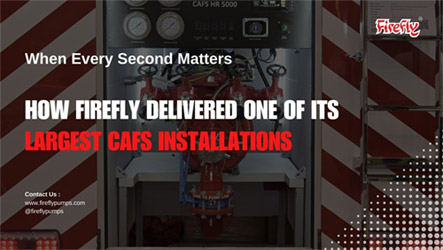
The recent Firefly installation involved multiple CAFS units, marking the largest order of its kind in the company’s history.
The project timeline was ambitious.
Large-scale firefighting system installations are rarely straightforward.
Every site has its own infrastructure, operational demands, and environmental considerations. This means that installations must often be adapted dynamically during execution.
For this project, the Firefly team worked closely with the client to ensure the system aligned perfectly with operational requirements.
Processes were adjusted, configurations refined, and every component was carefully calibrated to ensure optimal performance.
Four Days to Installation
Once the equipment reached the site, the clock started ticking.
The installation team had four days to set up the entire system and prepare it for commissioning.
Every step required precision:
Firefighting equipment must perform flawlessly when needed. Unlike many industrial systems, firefighting technology is often used during high-risk emergencies where failure is not an option.
Because of this, testing and commissioning are critical stages of any installation.
By the fourth day, the system was ready.
Commissioning Day: Performance Beyond Expectations
The commissioning demonstration brought together key members and observers.
Among them were municipal fire officers, who attended the site to witness the system in action.
When the CAFS system was activated, the results were immediate and impressive.
The foam discharge was powerful, stable, and highly effective in demonstrating the system’s suppression capability.
Observers were able to see firsthand how CAFS technology can rapidly blanket fire sources, cooling surfaces while simultaneously starving the fire of oxygen, a key mechanism in foam-based firefighting (Weinschenk et al., 2017).
Following the initial commissioning, a second demonstration was conducted, which again delivered successful results.
The installation confirmed that the system was capable of operating reliably and efficiently in demanding conditions.
Why CAFS Technology Matters in Real Emergencies
Modern firefighting increasingly relies on technologies that improve both speed and efficiency.
CAFS provides several critical advantages:
Foam produced by CAFS spreads rapidly and adheres to burning surfaces, helping extinguish flames more quickly than traditional water streams (Yang et al., 2025).
Because foam expands significantly, CAFS systems can suppress fires using less water while maintaining effective coverage (Zhang et al., 2024).
Foam-filled hose lines can be lighter and easier to handle, improving mobility and reducing fatigue during firefighting operations (Weinschenk et al., 2017).
The foam blanket left behind by CAFS helps prevent re-ignition by insulating surfaces from oxygen and heat.
These advantages are why CAFS systems are increasingly used in:
Training: Ensuring Long-Term Effectiveness
A firefighting system is only as effective as the people who operate it.
Following the successful commissioning, training sessions were conducted for operational teams to ensure they could confidently operate and maintain the CAFS system.
Training covered:
These sessions ensure that when a real emergency occurs, teams can respond quickly, safely, and effectively.
Industry Recognition
The commissioning demonstration also drew attention from industry stakeholders.
Representatives from Scania, known globally for its commercial vehicle engineering, were present during the commissioning and observed the system in action.
Their positive response reinforced the performance and reliability of the Firefly CAFS system.
Industry validation plays an important role in advancing firefighting technologies and building confidence in solutions that enhance emergency response capabilities worldwide.
More Than Technology: The Human Side of Fire Safety
Behind every fire incident are people.
Families, workers, communities, and the firefighters who risk their lives to protect them.
Firefighting equipment is not just machinery.
It represents preparedness, protection, and trust.
Every system installed today becomes part of a safety network designed to respond when emergencies occur.
For Firefly, this understanding shapes every project.
The goal is not simply to deliver equipment, but to deliver solutions that help firefighters act faster, safer, and more effectively when lives and infrastructure are at risk.
A Milestone for Firefly Fire Pumps
The successful installation of multiple CAFS units marks a major milestone in Firefly's journey.
It demonstrates the company's ability to execute large-scale firefighting technology deployments while maintaining precision, reliability, and performance.
But beyond numbers and specifications, the project highlights something deeper:
Because when a fire starts, preparation becomes the difference between control and catastrophe.
Through innovation, collaboration, and commitment to fire safety, Firefly continues to contribute to a world where emergency responders are equipped with the tools they need to protect lives and infrastructure.
And when the alarm sounds, every second counts.
Firefly ensures those seconds matter.
 Spanish
 Russian
 Arabic
 French
 Portugal
 German
 Polish
 Indonesia
 Turkish